
What is Harvey Workflow Builder?
Harvey Workflow Builder is a no-code platform that lets law firms build custom AI workflows—composing LLMs, conditional routing logic, integrations with legal databases, and firm-specific knowledge into end-to-end automation. Think Zapier for legal work, but with the compliance and auditability BigLaw demands. For background on what is Harvey AI and how this Harvey AI startup reached an $8B valuation, see our full company profile.
Harvey Workflow Builder Demo
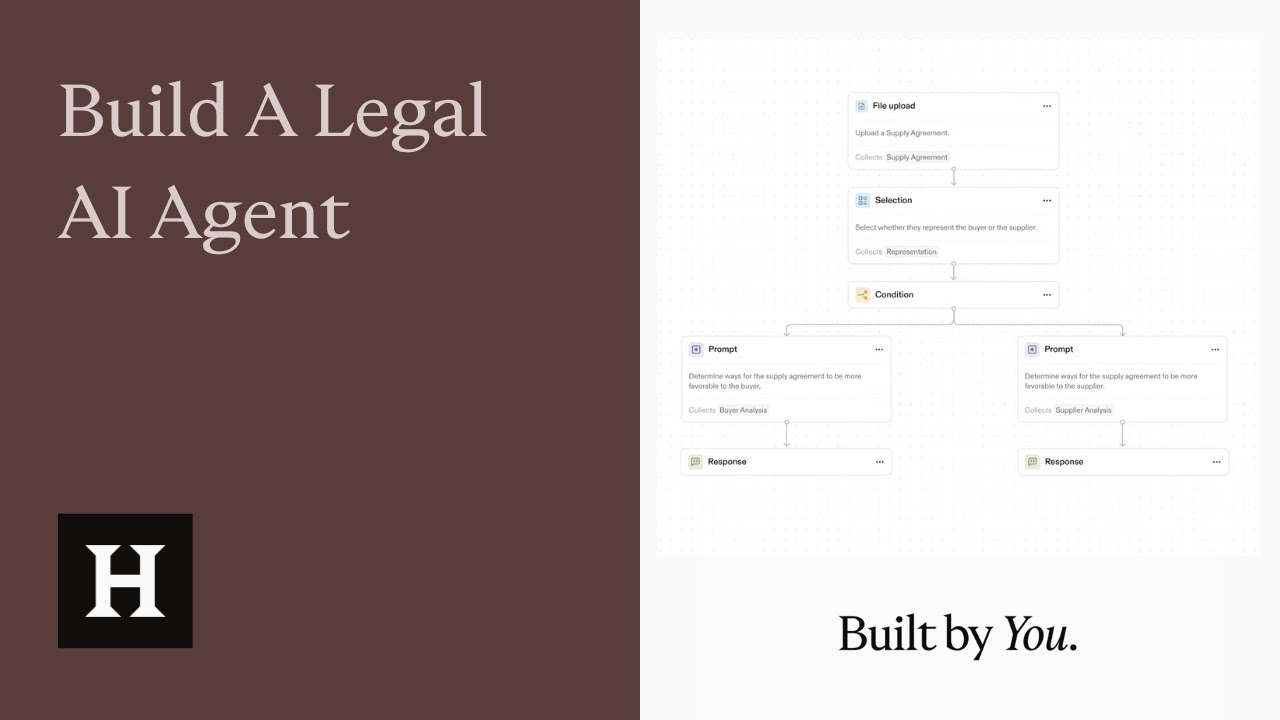
Since launch, firms are creating 300+ workflows per week—a velocity that would be impossible with traditional software development.
Why This Matters: From Chatbot to Infrastructure
The shift from "AI assistant" to "AI workflow" is the difference between a tool you use and infrastructure you depend on.
A chatbot answers questions. A workflow encodes how your firm thinks.
When a senior partner retires, their judgment walks out the door. Workflow Builder captures that judgment in executable form—the questions they ask, the documents they check, the thresholds that trigger escalation.
This is the vertical agent thesis becoming operational. The moat isn't the model—it's the workflow data that accumulates with every automation a firm builds.
The Architecture: Cascading Intelligence
Harvey doesn't rely on a single monolithic model call. Instead, it uses a cascading architecture designed to balance cost, speed, and accuracy:
Orchestration Layer
When a workflow is triggered, a "router" model analyzes request complexity and selects the appropriate execution path.
Specialized Model Selection
- Reasoning Models (o1-preview/GPT-4): Deployed for complex legal reasoning
- Fast Inference Models: Used for formatting and summarization to reduce latency
- Legal-Specific Fine-Tunes: Models trained on case law (via OpenAI partnership) for citation accuracy
Vault Integration (RAG)
Workflows pull directly from the firm's Vault—a secure container of internal precedents—bypassing generic training data in favor of firm-specific knowledge.
How It Works
Harvey co-founder Gabe Pereyra describes Workflow Builder as "a Zapier-like platform that lets law firms build workflows specialized for their firm's practice."
The interface uses a visual canvas where different logic blocks connect to create executable flows:
| Block Type | Function |
|---|---|
| Prompt Blocks | LLM instructions with "Firm Style" constraints enforced at the system level |
| Conditional Logic | Branching paths (e.g., "If Supply Agreement, run Playbook A; if NDA, run Playbook B") |
| Review Nodes | Human-in-the-loop blocks that pause until senior lawyer approves—essential for malpractice mitigation |
| Citation Validation | Cross-references outputs against LexisNexis to hallucination-check case law before the user sees it |
| Retrieval | Pull from Vault, case law databases, financial databases, firm knowledge |
The architecture mirrors the graph-based patterns that separate production agents from chat-loop demos. Workflows are DAGs (directed acyclic graphs), not conversations.
Agentic Capabilities: "Thinking States"
Unlike linear automations (Step A → Step B), Harvey's newer agents use iterative planning:
- Plan & Adapt: Given a vague goal ("Draft a UAE-compliant shareholder agreement"), the agent generates a multi-step plan, executes the first step, evaluates the result, and self-corrects if insufficient.
- Transparency: The UI exposes "Thinking States" so lawyers can see why the AI chose a specific clause—treating the AI's logic as a verifiable audit trail.
Words to Workflows: Plain English to Automation
The breakthrough feature: describe a workflow in plain English, and Harvey generates it automatically.
From Pereyra's thread:
”"Let lawyers describe a workflow in plain text, and use LLMs to turn that into a workflow instantly."
A lawyer types:
”"Ask the user to upload a supply agreement and whether they represent the buyer or the supplier. If they are the buyer, determine ways for the supply agreement to be made more favorable to the buyer, otherwise, determine ways for it to be more favorable to the supplier."
Harvey decomposes this into steps, transforms those steps into executable blocks compatible with the workflow engine, and generates a visual flowchart with branching decision paths.
This is the Karpathy pattern applied to legal: the best interface is natural language, but the execution is structured.
The Traction: 300+ Workflows Per Week
Workflows/Week
300+
Created by law firms since launch
The adoption curve tells the story. From Pereyra's metrics:
- May 2025: ~50 workflows per week
- July 2025: 300+ workflows per week
- Trajectory: 6x growth in two months
This velocity would be impossible with traditional development. Each workflow would require:
- Requirements gathering with attorneys
- Engineering specification
- Development and testing
- Compliance review
Workflow Builder compresses this to hours. Attorneys build what they need, when they need it.
Who's Using It
Harvey AI customers include the world's largest law firms, and Workflow Builder launched with several of them:
- Paul Weiss — "Partners with Harvey AI on New AI Workflows Innovation"
- A&O Shearman — Launching AI agents for complex legal tasks
- Ashurst — Early adopter of workflow automation
These aren't experiments. They're production deployments at firms with 3,000+ lawyers. See our Harvey legal AI deep dive for the full customer list.
The Business Model Innovation: Revenue Sharing
Here's where it gets interesting.
From Law.com:
”"A&O Shearman is providing custom workflows built with Harvey to clients on a SaaS subscription model, splitting revenue with Harvey."
This inverts the traditional legal services model:
| Traditional | Workflow Model |
|---|---|
| Bill hourly for attorney time | Charge subscription for workflow access |
| Value = hours worked | Value = outcomes delivered |
| Knowledge walks out when attorneys leave | Knowledge encoded in reusable automation |
| Each matter starts from scratch | Each matter builds on institutional IP |
A&O Shearman isn't just using Harvey—they're reselling Harvey workflows to clients. The law firm becomes a software company. But this raises important questions about IP ownership when firms encode institutional expertise into a vendor platform.
This is Service-as-Software in action. Law firms that master workflow creation will capture margin from both legal services AND software subscriptions. Firms that don't will compete on hourly rates against AI-augmented competitors.
Example Workflows
From the Workflows dashboard shown in Pereyra's thread:
M&A / Transactions:
- Analyze Change of Control Provisions
- Draft an Interim Operating Covenants Memo
- Draft an Item 1.01 Disclosure
Contract Analysis:
- Extract Key Data from Contracts
- Extract Terms from Side Letters
- Supplier Agreement Analysis (buyer vs. seller optimization)
Compliance:
- Regulatory change impact analysis
- Policy comparison workflows
Each workflow combines retrieval from Harvey's Vault, firm-specific knowledge bases, and external databases (case law, financial data, tax databases) into end-to-end automation.
Platform vs Point Solution: The Strategic Framing
Harvey has positioned Workflow Builder as a platform play, not a feature. The contrast with competitors is deliberate:
Harvey vs. Pre-Built Legal AI
| Feature | Harvey Workflow BuilderPopular | CoCounsel / Pre-Built AI |
|---|---|---|
| Philosophy | "Lego Kit": You build the logic; we provide the bricks | "App Store": Pre-built skills you pull off the shelf |
| IP Ownership | Firm owns the workflow logic as competitive advantage | Vendor owns the skill; every firm uses the same tool |
| Data Source | Hybrid: Public case law + deep private Vault integration | Public law + client document upload (less persistent) |
| Customization | Unlimited firm-specific workflows | Pre-defined tasks with limited modification |
The "Secret Sauce": Harvey's uniqueness lies in allowing firms to productize their own expertise. A top-tier firm like Paul Weiss can encode their specific approach to private equity deal reviews into a workflow that junior associates run—effectively scaling their best partners' intelligence.
The Skeptic's View: What Critics Say
The Bull Case
- "Build Your Own" Power: Innovation teams love creating firm-branded tools without hiring engineers. It validates the Knowledge Management function.
- Speed & UX: In benchmarks, Harvey is consistently rated faster than competitors with a cleaner, "Apple-like" interface.
- Prestige Signal: The invite-only exclusivity and partnerships with elite firms (A&O Shearman, PwC) created a halo effect. It feels like "the BigLaw AI."
- Citation Quality: The LexisNexis integration has significantly improved trust in research outputs compared to generic ChatGPT.
The Bear Case
- Opaque Pricing: Users complain about "black box" enterprise pricing. Quotes of £200+ per lawyer/month (before discounts) scare off mid-market firms. Small firms feel excluded.
- The "Junior Associate" Ceiling: Senior partners often find outputs "impressive for a robot but useless for a client." It excels at first drafts but struggles with nuanced strategic advice.
- Hallucinations in Complex Logic: Users still report missed "deal-breaker" clauses in complex LPAs or misinterpreted waterfall payout structures.
- Latency in Heavy Workflows: Complex multi-step workflows can take minutes, breaking the "instant" gratification loop.
PMF Reality: Harvey has strong product-market fit with the top 1% of the legal market who view AI as infrastructure. It has weak PMF with small law (who prefer ready-made tools like Spellbook or CoCounsel) due to cost and setup complexity.
The Workflow Moat
Every workflow a firm builds becomes institutional IP with compounding switching costs:
Lock-in mechanics:
- Workflow volume: 300+ workflows/week means thousands of firm-specific automations within months
- Knowledge encoding: Senior attorney judgment captured in executable form
- Client dependencies: Clients subscribe to firm workflows—switching firms means losing access
- Improvement flywheel: Usage data improves workflow performance over time
This is why Harvey's $8B valuation isn't about the model. It's about becoming infrastructure that firms literally cannot remove without rebuilding years of encoded expertise.
The Bigger Picture
Workflow Builder represents the maturation of legal AI from "better search" to "encoded expertise."
The firms building workflows today are:
- Capturing institutional knowledge before senior attorneys retire (The Hollow Firm problem)
- Creating new revenue streams by reselling AI workflows to clients
- Shifting pricing models from hourly billing to subscription confidence
The risk for firms that wait: competitors with thousands of workflows will operate at fundamentally different economics. The gap between "uses AI" and "runs on AI" is measured in years of accumulated workflow IP.
What's Next: Background Agents
Harvey is moving aggressively from "chat with a PDF" toward background agents:
- Long-Running Tasks: "Set and forget" workflows (e.g., "Monitor the Federal Register for changes affecting Client X, and draft a memo if one appears")
- Deep Analysis Across Sources: Combining public web research, proprietary firm documents, and legal databases into a single reasoning stream
- The "Service" Pivot: Through the PwC partnership, Harvey is blurring the line between software and service. The roadmap implies a future where Harvey doesn't just help with the tax filing—it does the filing, with a human merely signing off.
This aligns with the broader agentic category evolution: from copilots to autonomous operators.
What This Signals
Harvey Workflow Builder validates several theses:
-
No-code wins in verticals. Attorneys won't learn to code, but they'll describe workflows in English.
-
Graphs beat chat loops. The Zapier-like canvas interface proves that structured orchestration is the production pattern.
-
Workflow data is the moat. Model capability commoditizes; firm-specific automations don't.
-
Law firms become software companies. Revenue sharing with clients is just the beginning.
The question isn't whether your firm will adopt workflow automation. The question is whether you'll build 1,000 workflows before your competitors do.
Harvey: The $8B Legal AI That BigLaw Actually Trusts
How Harvey became the category-defining legal AI by solving what ChatGPT couldn't: data privacy through the Vault, 0.2% hallucination rate through citation-backed generation, and workflow integration at 4,000-lawyer firms. The definitive case for vertical AI.
Vertical Agents Are Eating Horizontal Agents
Harvey ($8B), Cursor ($29B), Abridge ($2.5B): vertical agents are winning. The "do anything" agent was a transitional form—enterprises buy solutions, not intelligence.
The Graph Mandate: Why Chat-Based Agents Fail in Production
The "Chat Loop" is the "goto" statement of the AI era. 70-90% of enterprise AI projects stall in Pilot Purgatory. Graph architectures are the path to production.
The Hollow Firm 2.0: What Happens When Juniors Disappear
AI is automating junior work in law, consulting, and finance. Short-term margin expansion, but a 2035 succession crisis when AI-trained juniors become senior experts.